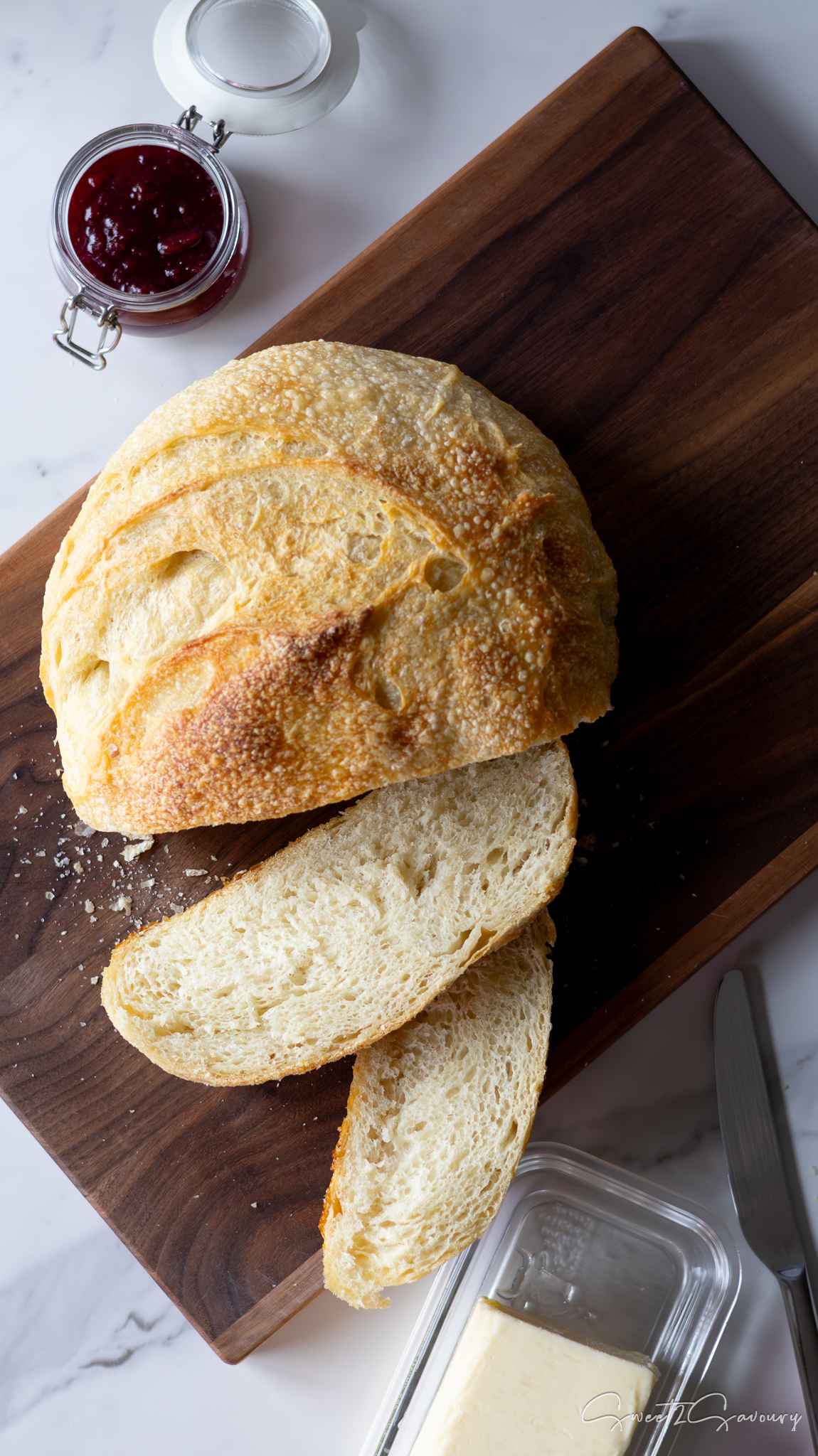
Foolproof Sourdough Bread (Crispy Crust & Soft Center)
Servings: 1 loaf
Calories: 1607kcal
This sourdough has a golden, crispy crust and an airy, soft center—please note that this recipe does not include making a sourdough starter from scratch. This guide is perfect for those who already have a sourdough starter ready to go!
Print Recipe
Ingredients
For the Poolish (pre-ferment)
- ¾ cup unbleached bread flour
- ½ cup (minus 2 teaspoons) filtered water room temperature
- ½ cup sourdough starter room temperature
For the Dough
- 2¼ cup unbleached bread flour
- ¾ cup filtered water room temperature
- 1 teaspoon salt kosher or sea salt
- 1 teaspoon white sugar
- 1 Tablespoon olive oil extra virgin

Instructions
Day 1: For the Poolish (Pre-Ferment)
- In a medium glass bowl, combine the unbleached bread flour, room-temperature filtered water, and active sourdough starter. Stir until fully combined. Cover with plastic wrap and a clean kitchen towel.
- Let it sit at room temperature for 2 to 4 hours, or until it has doubled in volume and is full of small bubbles. (Note: If your kitchen is cool, place the bowl in the oven with the oven light on).
Day 1: For the Dough (Autolyse)
- In the bowl of a stand mixer, add the bubbly poolish, bread flour, and filtered water. Using a dough hook, mix on low speed until just combined into a shaggy dough.
- Stop the mixer, cover the bowl with a clean towel, and let it rest for exactly 20 minutes. (This process is called autolyse and helps develop gluten).
Day 1: Knead & Bulk Fermentation
- After the 20-minute rest, add the kosher salt and white sugar to the bowl. Mix on medium speed for 7 minutes (or knead by hand for 15 minutes) until the dough is smooth, pliable, and pulls away from the sides of the bowl. Reduce the speed to low and drizzle the olive oil in to coat the dough evenly.
- Transfer the dough to a piece of parchment paper, shape it into a round ball (seam side down), and place it in a large bowl. Cover loosely with plastic wrap and a towel.
- Let it rise in a warm spot for 2 to 4 hours, or until it becomes puffy and doubles in size.
Day 1: Lamination (Stretch & Fold)
- Lift the parchment with the dough onto the counter. Gently stretch the dough outwards into a large rectangle, then fold it over itself (like an envelope). Shape it back into a tight round loaf, place it back on the parchment, and cover it again. Set a timer for 40 minutes.
- After 40 minutes, flip the dough over (keeping the seam on the same side) and repeat the stretch and fold process.
- Repeat this stretching and resting process 2 more times, waiting 40 minutes between each fold.
Day 1: Overnight Cold Proof
- After the final fold and pinch, cover the bowl lightly with plastic wrap (don't wrap the sides to allow dough room to rise) and a clean towel.Place it in the refrigerator for 12 to 15 hours (overnight) to cold-proof. Ensure nothing is pressing down on the dough.
Day 2: Score and Bake
- Preheat your oven to 475°F (246°C). Position your oven racks on the lowest and mid-lowest levels. Place a baking tray on the lowest rack, and an empty Dutch oven (with the lid on) on the mid-lowest rack to preheat.
- Remove the dough from the fridge. Using a lame or sharp knife, make a deep slash across the top of the dough (or a pattern of your choice). Drizzle with a little olive oil and sprinkle with sea salt.
- Using oven mitts, carefully remove the hot Dutch oven. Take off the lid and add a handful of ice cubes inside.
- Using the parchment paper, carefully lower the dough into the pot on top of the ice cubes. Generously mist the dough with water, quickly close the lid, and place it back in the oven. Bake for 40 minutes.
- After 40 minutes, remove the lid and rotate the pot 180°. Spray the loaf and the inside of the oven with water once more. Bake uncovered for another 10 to 15 minutes until the crust is deeply golden brown.
- Transfer the bread to a wire rack and let it cool for at least 1 hour before slicing to ensure the center sets perfectly and the exterior has a crispy crust.
Video
Notes
Read the Dough, Not the Clock: Fermentation times will vary widely based on your kitchen’s temperature. In a warm summer kitchen, bulk fermentation may only take 2 hours. In the winter, it could take 4+. Watch for the dough to be bubbly and doubled in size, regardless of the time.
Nutrition
Serving: 1loaf | Calories: 1607kcal | Carbohydrates: 300g | Protein: 48g | Fat: 21g | Saturated Fat: 3g | Polyunsaturated Fat: 4g | Monounsaturated Fat: 11g | Sodium: 2350mg | Potassium: 376mg | Fiber: 10g | Sugar: 5g | Vitamin A: 8IU | Calcium: 67mg | Iron: 3mg
